Prophet Muhammad (PBUH), the Prophet of Islam, was born in Mecca in the 7th century AD. He is the last prophet of Islam and the bearer of the Holy Quran. Prophet Muhammad is known as Al-Rahmah Lal-Alameen (Mercy for the Worlds) and he explained Islamic principles to humans. His life and actions are recorded in the Islamic book of the Qur'an and Sunnah (Tradition).
Hazrat Muhammad said, I was sent only to implement and reform morals, in such a way that the Arabs used to bury their daughters alive, and they considered women only as a means of sexual intercourse and reproduction, but the Prophet came and all these wrong customs destroyed and gave value to women, to the extent that the Arab leaders said that Muhammad came and humiliated us women (that is, he humiliated us in front of women))

the Prophet
Islam
Hazrat Muhammad (PBUH)
Hazrat Fatima (peace and blessings of Allah be upon him), the beloved daughter of the Prophet of Islam, was born in Mecca in 590 AD.
Hazrat Fatima Zahra is the wife of the first Imam of Shiites (Imam Ali) and the mother of Imam Hassan and Imam Hussein (AS), who is mentioned in the Bible and Torah as Shabar and Shabir. They have a high position until the Prophet called them Umm Abiha (Mother of the Father) and introduced them as Sayyida al-Nisa al-Alamin (Lord of Women)..
One of the exemplary morals of Hazrat Zahra is to pay attention to the conditions of people, neighbors and the needy. On her wedding night, she gave her wedding dress to a poor person.
First, you should think about the problems and comfort of your neighbors and relatives, and then think about yourself.
At the age of eighteen, in the year 11 Hijri, on Tuesday, 75 days or 95 days after the martyrdom of her noble father, her child was aborted and martyred by the first and second caliphs and their followers..
![]()
Prophet's daughter
Hazrat Zahra (s.a)
Imam Ali (peace be upon him), the first Imam of Shiites, took place on the 13th of Rajab in the 30th year of the Elephant. According to Shia scholars and a large group of Sunnis, the birth of that Prophet took place in the House of God (Kaaba). This flow is one of the prerogatives of His Holiness and has no precedent in the history of mankind and has not been repeated since then.
Imam Ali (peace be upon him) does not have and did not have an example in his actions, piety and courage, the Prophet said about him: Ana Madina al-Ilam wa Ali Babha (I am the city of knowledge and Ali is in it) God in the Holy Qur'an in the verse of Mubahlah (Surah Aal Imran verse 61) He called Imam Ali the soul of the prophet.
The father of Imam Ali, peace be upon him, is Abu Talib bin Abdul Muttalib, who with Abdullah bin Abdul Muttalib was the father of Prophet Muhammad, may God bless him and his family, his brother and their mother Fatimah bint Amr bin Ayez Makhzoumi. [1] Abu Talib was the one who was the guardian of Prophet Muhammad after the death of Abdul Muttalib. He took over the Prophet (PBUH) and when he became a prophet, he supported him.[2]
His mother was also Fatima bint Asad bin Hashim bin Abd Manaf, and Hazrat Ali (peace be upon him) and his brothers and sisters were the first ones who were Hashemites from both their father's and mother's sides..

First imam
Imam Ali)(a.s)
Imam Hassan (peace be upon him) was born in Madinah on the night of the 15th of Ramadan in the third year of Hijrah. He is the first child of Imam Ali (a) and Fatima (pbuh) and the first grandson of the Prophet (pbuh) and the second Imam of the Shiites.
His most famous nickname is Mojtaba.
Twice he gave all his property in the way of God and three times he gave half of his property to the needy. It has been said that because of these benevolences, they called him "Karim Ahl al-Bayt".
Imam Hasan Mojtabi (a.s.) reached the Imamate and Caliphate on 21st Ramadan of the 40th lunar year, and after the martyrdom of Imam Ali (a.s.), and on the same day, thousands of people pledged allegiance to him. Muawiya did not accept his caliphate and moved with an army from Syria to Iraq. During the plans of Muawiya
Imam Hassan Mojtabi (a.s.) accepted peace and handing over the caliphate to Muawiyah on the condition that Muawiyah acts according to the Book of God and the Sunnah of the Prophet (pbuh) and does not appoint a successor for himself and that all people, including the Shiites of Ali (a.s.), are safe. . After that, Muawiya did not fulfill any of these conditions.
When Muawiya decided to take allegiance for the succession of his son Yazid, he sent one hundred thousand dirhams to Jaedah, the wife of Imam Hassan (AS), to poison the Imam, and they were martyred on 28 Safar, 50 Hijri at the age of 48...

The second imam
Imam Hassan Mojtabi (AS)
Imam Hussain (AS) was born in Madinah on the 3rd of Sha'ban, 4th year of Hijri
Hossein bin Ali is the third imam of Shiites. His titles are Aba Abdullah and Syed al-Shohda.
Imam Hussein (AS) is the second child of Imam Ali (AS) and Hazrat Fatima (AS) and the grandson of Hazrat Muhammad (AS).
Yazid was a cruel and unbelieving person and he had obtained the caliphate unjustly. He wanted to take allegiance from Imam Hussain (AS) by force, but Imam Hussain did not give in under the burden of oppression and oppression.
Imam Hussain (a.s.) received many letters from the people of Kufa to accept leadership, and after his envoy Muslim bin Aqeel confirmed the sympathy of the Kufas, on the 8th of Dhu al-Hijjah, before he learned of the subsequent breach of the Kufa agreement and Muslim's martyrdom, he moved to Kufa. did.
When Ubaidullah bin Ziyad, the governor of Kufa, learned about the movement of Imam Hussain (AS) towards Kufa, he prepared a huge army to fight against Imam Hussain.
After the troops of Hur bin Yazid blocked the road to Imam Hussain (a.s.), he had no choice but to change his route towards Karbala.
On the Ashura day of the 10th of Muharram in the year 61 AH, a war broke out between Imam Hussain (a.s.) and his companions, who were about 72 people, and the Kufa army, who were about 30,000 people under the command of Omar bin Saad, which resulted in the martyrdom of the third Shiite imam, his companions, and even his six-month-old baby.
After the martyrdom of Imam Hussain, the women and children of his family were taken captive and along with Ibn Ziyad's army, they left for Syria on foot.
The mausoleum of Imam Hussain (AS) is located in Karbala in Iraq, which has millions of pilgrims every year.

The third imam
Imam Hussain (AS)
Ali bin Hossein, known as Imam Sajjad and Zain al-Abidin, is the fourth Imam of Shiites
He was born on the 5th of Sha'ban or the 15th of Jumadi al-Thani in the 38th lunar year in Madinah.
Their father is Imam Hossein (a.s.) and their mother is Shahrbanu, the daughter of one of the great and famous people of Iran.
Imam Sajjad (AS) was present in the incident of Karbala; But due to illness, they could not participate in the war.
Omar bin Saad's army captured Imam Sajjad and the Ahl al-Bayt of Imam Hussain (a.s.) after the Karbala incident and sent them to Kufa and Sham. When the captives were taken from Karbala to Kufa, they put shackles on the neck of Imam Sajjad (a.s.) and because he was sick and could not hold himself on the camel's back, both of his legs were tied on the camel's stomach. His illness lasted for several days.
Hara incident, Tawabin movement and Qiyam Mukhtar took place during the time of Imam Sajjad (AS). The collection of supplications and supplications of Imam Sajjad (a.s.) is collected in the book Sahifah Sajjadiyeh.
Sahifah Sajjadiyeh, which is one of the most valuable works of Islam, contains 57 prayers that contain the most detailed monotheistic, religious, social and moral issues.
Imam Sajjad (a.s.) was martyred by poison on the 12th or 25th of Muharram, 94 or 95 lunar year, by the order of Walid bin Abdul Mulk. He is buried in Baqi cemetery next to the graves of Imam Hassan Mojtabi (a.s.), Imam Muhammad Baqir (a.s.) and Imam Jafar Sadiq (a.s.).

Fourth Imam
Imam Sajjad (a.s.)
Muhammad bin Ali known as Imam Muhammad Baqir (AS) (57-114 AH) is the fifth Shia Imam and the son of Imam Sajjad (AS) and Fatimah, the daughter of Imam Hassan (AS). The Prophet of Islam (PBUH) gave him this nickname before his birth
Baqir al-Uloom (AS) was the leader of Bani Hashim in science, asceticism, greatness and virtue, and he was one of the prominent teachers and had about 462 students.
He created a scientific movement that reached its peak during the Imamate of his son Imam Sadiq (AS).
He also expanded the curriculum and training of scientific and rhetorical elites
During his lifetime, 5 caliphs relied on the post of power.
The fifth imam, like all Shia imams, had good morals and good qualities, as well as a lot of knowledge and knowledge.
The fifth Imam (AS) was martyred on the 7th of Dhul-Hijjah in the year 114 AH at the age of 57. In some sources, Hisham bin Abdul Malik and in others Ibrahim bin Waleed are mentioned as the cause of his martyrdom. The shrine of Imam Muhammad Baqir (AS) is in Baqi Cemetery in Saudi Arabia.
The fifth imam
Imam Muhammad Baqir (a.s.)
Jafar bin Muhammad known as Imam Jafar Sadiq (AS) is the sixth Imam of Twelver Shiites. He was born on the 17th of Rabi-ul-Awl of the year 83 (lunar) equal to the 20th of April 702 in the city of Madinah.
Their father is Imam Muhammad Baqir (AS) and their mother is Umm Farouh.
Sadiq is his most famous nickname. This title has been applied to the 6th Imam of Shiites because of his truthfulness in words and actions براساس روایتی از امام سجاد(ع)، امام ششم، صادق خوانده شد تا از جعفر کذاب متمایز گردد.
During the era of Imam Sadiq, 7 caliphs relied on the post of power. And due to the turbulent political situation, there was more freedom to express one's opinion and many scientific discussions were formed on various topics. This scientific and religious freedom, which existed for less Imams than the twelve Imams, caused the Imam's students to freely participate in scientific discussions. The scientific open space caused many narrations from Imam Sadiq (a.s.) to be narrated in various fields of jurisprudence, speech, etc. Due to the weakness of the Umayyad government, Imam Sadiq (a.s.) was able to have much more scientific activity than other Shiite imams. The number of his students and narrators is 4000 people. Most of the traditions of Ahl al-Bayt (a.s.) are from Imam Sadiq (a.s.), he was a great scholar in the field of jurisprudence, and now Shia jurisprudence is Jafari jurisprudence. .
Imam Sadiq (a.s.) was martyred on the 25th of Shawwal 148 lunar year by the order of Mansoor Davanighi and due to poisoning. His grave is in Baqi Cemetery in Saudi Arabia..
The sixth imam
Imam Jafar Sadiq (AS)
Musa Ibn Jafar is the seventh Imam of Shiites.
He was born on 20 Dhu al-Hijjah 127 lunar year or 7 Safar 128 lunar year.
His father, Imam Sadiq (a.s.) and his mother, Hamidah Andalusia, were among the nobles of Ajam, and some consider them to be from Spain.
The reason why the 7th Shiite Imam was nicknamed Kazem was because he controlled his anger.According to Shia and Sunni sources, Imam Kazem (a.s.) was very religious; For this reason, the title of Abd Saleh is used for him. According to some reports, Imam Kazem (a.s.) worshiped so much that his jailers were also influenced.
About Musa bin Jafar's generosity, he said: He used to leave the house at night and had bags of dirhams with him, and he would reach out to anyone or give to those who looked at his benevolence, until his bags of money became proverbial. It is also said that Musa bin Jafar forgave those who hurt him
Imam Kazem (a.s.) was summoned and imprisoned several times by the Abbasid caliphs.
Matmoura is a prison that is like a well in such a way that it is not possible to stretch your legs and sleep in it. Imam Kazem (a.s.) spent several years of his blessed life in this prison.
He was martyred by Harun al-Rashid on 25 Rajab 183 lunar year by eating poison
His tomb is located in the city of Kazmin in Iraq. The Kazmin area is the tomb of Imam Kazim (a.s.) and Imam Javad (a.s.) in Baghdad..

The seventh imam
Imam Kazem (a.s.)
Ali bin Musa, known as Imam Reza, is the eighth Shiite Imam of the twelfth century. He was born on 11 Dhu al-Qaida 148 AH in Medina. Their father is Imam Musa Kazem (a.s.) and their mother is Najma Khatun
Some consider Najma Khatun to be originally from the city of Nube in North Africa and some from the island of Marseille in the south of France.
His most famous nickname is Reza. This title has a divine root and was given to him because he was pleased with God and the Messenger of God (PBUH), imams, friends and even enemies. Mamun was afraid of numerous uprisings of Alawites and Shiites to calm these uprisings
In the year 200 or 201 Qumari, he ordered Imam Reza (a.s.) to come to Mero, and the Imam accepted him as governorship with threats and reluctance. He was a true example of the motto of Al-Reza Man Al-Muhammad (pbuh) that the public's satisfaction with his governorship was unprecedented.
After bringing Imam Reza (a.s.) to Merv, Ma'mun organized several scientific meetings with the presence of various scholars. In these meetings, many discussions took place between the Imam and other scholars or thinkers of the world. In these debates, Imam Reza (a.s.) answered all religious, jurisprudential and scientific questions, etc. According to the history of Imam's debates in the history of Islam after The Holy Prophet was unprecedented.
He did not build the first university in the history of Islam, named Bayt al-Hikma.
Imam Reza was martyred at the end of the month of Safar in the lunar year 203 by poison in a grape from Mamun.
The tomb and shrine of Imam Reza (AS) is located in the city of Mashhad in Iran.

The eighth Imam
Imam Reza (a.s.)
Muhammad bin Ali, known as Imam Jawad and Imam Muhammad Taqi, is the ninth Imam of the 12th century Shiites. He is called "Jawad" because of his generous hand and generosity. He was born on 10 Rajab 195 lunar year in Medina.
His father was Imam Reza (a.s.) and his mother's name was Sabika. The mother of Imam Javad (a.s.) lived in Africa and was from a village in Egypt called Merisa. And she was considered one of the best women of that era.
Imam Javad reached the Imamate at the age of 8
From the point of view of Shia beliefs, Imamate is a divine gift .
God Almighty chooses whoever He deems worthy of the position of Imamate to the position of leader of the nation; The scale of old age, although it is considered a scale for reaching perfection among humans, but in the vision of revelation and the Qur'an, a person may have been given the virtues and perfections and conditions of leadership of the society by God in his childhood.
God, with his absolute power and wisdom,
According to the Qur'an, God can bring a person to the position of prophethood or imamate at a young age
He raised Jesus and Yahya (a.s.) to the position of prophethood in their childhood.
The Imamate of Imam Javad is considered a great miracle in Islam and in the history of Shiism due to his childhood and young age.
Imam Javad was martyred at the end of Dhul-Qa'da, 220 lunar year or 6 Dhul-Hijjah, 220 lunar year by poison from the government.
He was the youngest imam of the Shiites when he was martyred, and his age at the time of martyrdom was said to be 25 years
His tomb is in the city of Kazmin in Iraq..
The ninth imam
Imam Javad (a.s.)
Ali bin Muhammad, known as Imam Hadi or Imam Ali al-Naqi, is the tenth Shia imam and the son of Imam Javad (a.s.). His mother's name was Samaneh Maghribieh. Imam Hadi was born on 15 Dhul-Hijjah 212 AH in Saria (a region near Madinah).
The 10th Imam of the Shiites was called Imam Hadi (a.s.) because in the direction of public guidance, he made an eloquent effort to protect the Muslims from deviation and the fundamentals of Islam from distortion.
Ali bin Muhammad reached the Imamate at the age of eight. The young age of Imam Hadi (a.s.) at the beginning of the Imamate did not lead to doubts among the Shiites; Because Imamate of Imam Javad, his father, also started at a young age
The Abbasid caliphs restricted Imam Hadi (a.s.) and prevented him from communicating with the Shiites. For this reason, he was mostly connected with the Shiites through the lawyer organization, which consisted of a group of Imam's lawyers. By the order of the government, they were forced to go from Medina to Samarra and live there to be under the government's supervision
Imam Hadi (a.s.) was martyred by the government on 3 Rajab 254 lunar year.
And he was buried in the house where he lived in Samarra. The burial place of Imam Hadi (a.s.) and his son Imam Hassan Askari (a.s.) in Samarra is known as Haram Askariyin.
Samarra is located in Iraq..
The tenth imam
Imam Hadi (AS)
Hassan bin Ali bin Muhammad (pbuh) known as Imam Hassan Askari (pbuh) is the 11th imam of 12th century Shiites. He was born in Madinah on 8 Rabi al-Thani 232 lunar year. His father is Imam Hadi (pbuh) and his mother's name is Susan.
His most famous nickname is Askari, which refers to his forced stay in Samarra. He was under the strict care of the Abbasid government in Samarra and faced many restrictions for his activities. Imam Askari (a.s.) communicated with the Shiites through his representatives and also by writing letters
In the childhood years of Imam Hasan Askari (AS), along with their father Imam Hadi (AS), they were forcibly called to Iraq and were kept under surveillance in Samarra, the capital of the Abbasids at that time.
One of the factors that made the political situation more difficult for Imam Askari (a.s.) and the Shiites was the popularity of the uprising of the twelfth Imam (a.s.). Sheikh Mofid has described the period of Imamate of Imam Askari (AS) as a difficult time. He believes that the coming of the Imam had become famous in the Imami religion, and the Caliph, who knew that the Shiites were waiting for his arrival, was looking for the son of Imam Askari (a.s.) and made a lot of efforts to find out about him. It was for this reason that Imam Askari (AS) hid the birth of his son. He was martyred in Samarra on the 8th of Rabi al-Awwal in the lunar year 260..
The eleventh imam
Imam Hasan Askari (AS)
Mohammad ibn Hasan al-Askari (peace be upon him), known as Imam Mahdi, the Imam of Time and the last Imam of the Twelve Imam Shiites, is the divine savior of humanity. He was born in Samarra on the 15th of Sha'ban in the year 255 AH. His father was Imam Hasan al-Askari (peace be upon him), and his mother was Narjes Khatun.
In some ancient Shia sources, the mother of the Imam of Time (peace be upon him) is introduced as a Roman princess named Malika (Melika) bint Yusha, the granddaughter of Emperor Rome. Her lineage goes back to Simon, one of the companions of Jesus (peace be upon him), and she was the granddaughter of the King of Rome.
One of the names and titles of Imam Mahdi (peace be upon him) is the title "Sahib al-Zaman" (the Lord of Time). This name indicates one of his special positions in faith and Sharia.
The term "Sahib al-Zaman" illustrates the divine presence of Imam Mahdi (peace be upon him) in time, influencing the course of days and nights through his holy existence.
According to Shia sources, during the tenure of Imam Hasan al-Askari (peace be upon him), the Abbasid government tried to find the son as Mahdi and successor to his father. For this reason, the birth of Imam Mahdi (peace be upon him) was kept secret and no one saw him except a few close companions of Imam Hasan al-Askari (peace be upon him).
After his father's martyrdom, Imam Mahdi (peace be upon him) entered the "little absence" and during this time communicated with the Shiites through four special representatives. From the year 329 AH, people's connection with the Imam of the time (peace be upon him) through these special representatives also ended, and the "great absence" began.
According to our Shia belief, Imam Mahdi (peace be upon him) is alive and will one day appear to establish global rule together with his followers and free the world from injustice and tyranny, filling it with justice and justice..
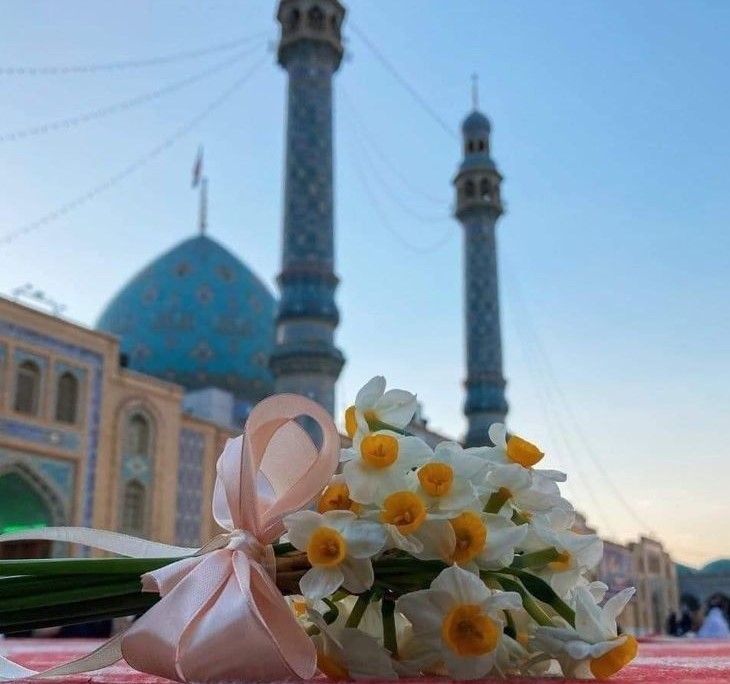
Twelfth Imam (Friede sei mit ihm):
Imam Mahdi